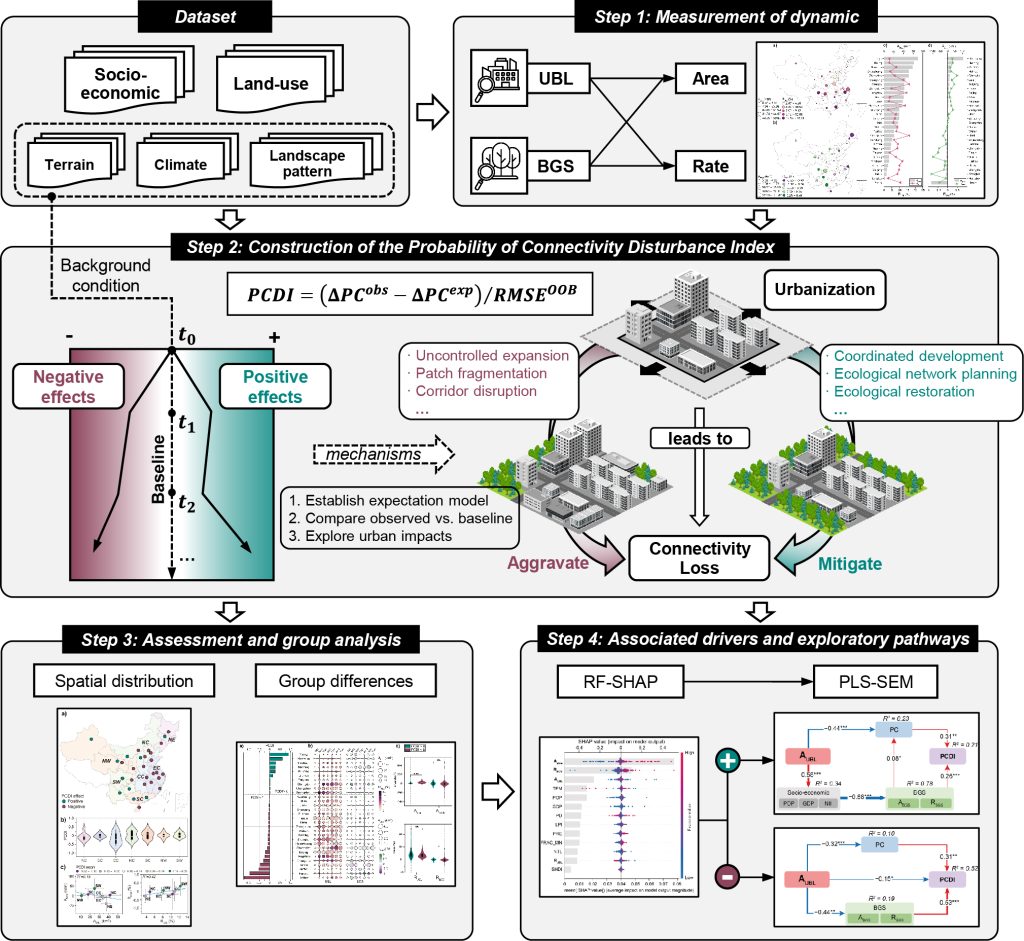
Rapid urbanization is widely recognized as a major driver of landscape connectivity (LC) loss. However, the combined effects of natural and human-driven processes have limited our understanding of the specific impacts of urban expansion on LC. In particular, clarifying the effects of changes in urban built-up land (UBL) and blue-green space (BGS) on LC is crucial for LC conservation and urban planning. This study introduces the Probability of Connectivity Disturbance Index (PCDI), a disturbance-based and process-oriented indicator that establishes a background-conditioned expected baseline and quantifies standardized residual deviations in landscape connectivity change. Taking 30 Chinese cities from 1990 to 2020 as case studies, we assessed the impacts of UBL and BGS changes on LC and examined associated drivers and exploratory pathway structures using Random Forest-SHAP analysis and structural equation modeling. The results indicate that all cities experienced UBL expansion, while BGS increased in 16 cities. Only 10 cities exhibited positive PCDI values, mainly concentrated in the western region. LC residual deviations were jointly associated with UBL expansion and BGS compensation in land-cover terms, with cities following divergent patterns of ecological buffering or degradation, reflecting differences in expansion patterns, ecological baselines, and the balance between UBL expansion and BGS change. Overall, this study advances the understanding of the relationship between urbanization and LC change. It also provides a standardized analytical framework for cross-city comparison and macro-scale assessment of the environmental impacts of urbanization, contributing to ecological protection and sustainable urban development.